
Within the last year, I lost both of my parents.
They’d been together for close to 60 years, and in all that time they’d rarely, if ever, experienced truly unconditional love or acceptance.
You may wonder how I know this.
I know this from listening to them argue for 58 years about why my mother wasn’t doing things the way my father wanted her to, and why my father wasn’t behaving the way my mother wanted him to behave.
This is not to say that they didn’t love each other at all, but rather that they were unable to accept, and therefore unable to love, each other exactly the way they were.
My mother, for example, hated the way my father drove, and my father couldn’t bear the way my mother handled the car when she was driving.
My mother was disgusted by the way my father treated his employees, and my father was disgusted by my mother’s need for control.
These were issues that often led to hostility between them.
Not only were my parents unable to accept or love each other unconditionally, but they also struggled to accept and love their children unconditionally.
If my siblings and I wanted to feel loved, we needed to bury those parts of ourselves that our parents found unacceptable.
I’m not bringing any of this up to embarrass or shame my parents, but rather to demonstrate how difficult it is to accept anyone so unconditionally that you would not want a single thing about them to be different, and, in the event that something about them was to change, you’d accept the new version of them with the same ease.
A lesson to be learned from my parents’ example is that:
Each of them believed that THE OTHER WOULD NEED TO CHANGE for them to feel happy and at ease.
I could easily have lived my entire life with that same expectation, but paradoxically, I’m fortunate because my entire life fell apart roughly fifteen years ago forcing me to take a very close look at the way I was relating to my partners, my family, my daughter, and every person I worked with and came into contact with.
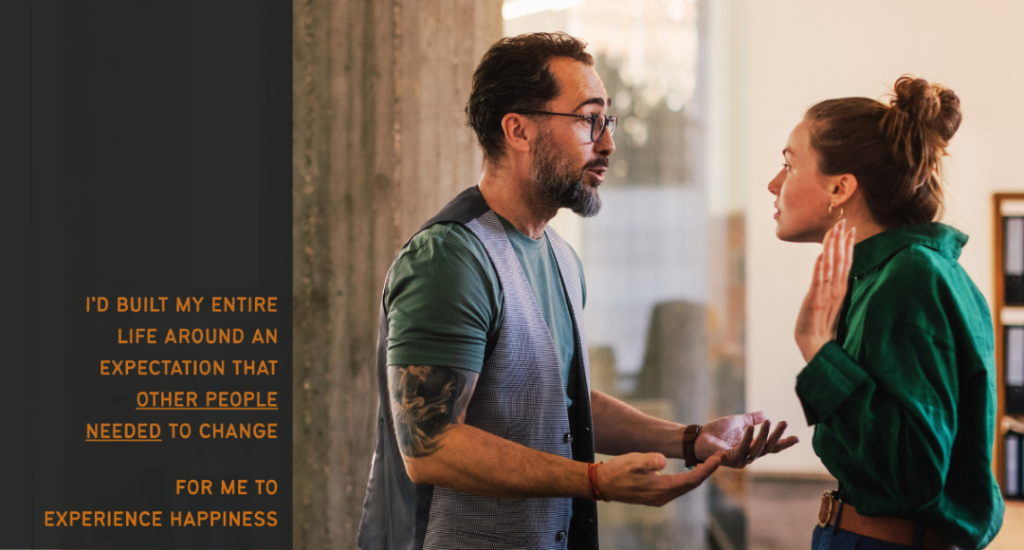
UNTIL THEN, I’D BUILT AN ENTIRE LIFE AROUND THE EXPECTATION THAT OTHER PEOPLE NEEDED TO BE DIFFERENT FOR ME TO BE HAPPY.
The collapse of my world forced me to confront this reality: The only person I can change is myself!
If I wanted my life to be different, I needed to let go of my desire for people to change and replace it with full acceptance of them exactly the way they are.
When I proposed in a post the other day that we could benefit from practising unconditional acceptance and loving at work, most of the comments spoke to how challenging and foreign this proposal appeared.
Here are some examples:
I appreciate each of these thought-provoking responses and all the others that were shared, and I agree that my proposal is as daunting and challenging as they’ve described, so let me describe what unfolded when I succeeded in transforming the way I regarded other people.
When I finally reached a point where I could UNCONDITIONALLY ACCEPT A hostile person without needing them to be different, miraculous changes began to unfold:
I realized that their hostility was not directed at me because of who I am; it was directed at me because of who they are, and because they were in distress.
This meant that I could double down on BEING MYSELF and accepting myself exactly the way I am.
I allowed myself to fall in love with myself, and this enabled me to become more confident, attractive, and compelling to many of the people interacting with me.
My nervous system wasn’t getting triggered nearly as often because it recognized that the problem didn’t lie with me.
It lay with the person who was in distress, and there was no need for me to get flustered or scared when they were having a tantrum or ‘a sad’.
When I stopped responding to other people’s distress, I disrupted patterns that had consistently led to escalation in tensions.
These dynamics required the scripted participation of both parties, and I’d changed my script.
When they were no longer getting the emotional rise they were seeking from me, they redirected their hostility elsewhere.
I became more confident in setting boundaries and protecting myself from their hostility because the real problem lay with them, and I knew that I was okay with myself.
However, the way that I set boundaries and defended myself now reflected the compassion that I was beginning to feel toward them; these changes in HOW I was relating landed differently with the person.
They were now receiving a message that at least one person could ‘see’ their distress and could sympathize with them.
I was doing this effortlessly, unconsciously, and in such a subtle way that it didn’t come across as shaming.
I wasn’t being loving and accepting because I wanted something from my co-workers.
I was relating to them in this way because it BROUGHT ME JOY and generated a feeling of connectedness for me, but my ability to accept and love was impacting my environment in a beneficial way while also modelling a more peaceful and harmonious way of being.
The path toward Unconditional Loving and Acceptance begins when you observe what you’re judging in yourself and in other people.
Don't Miss Out On
Original insights and content from Philip Be'er
Challenging your understanding of how humans are 'wired' and why it matters.
Copyright ©Advantages Mediation. All Rights Reserved