
“Circle-of-Belonging” is the concept I’ve developed to help explain why members of our species keep doing terrible things to each other—and why, despite all our magnificent accomplishments and the length of time we’ve been at this, we still can’t seem to stop ourselves from behaving this way.
If you happen to be someone who wants things to be different, then listen up:
Every human being is born with two handicaps:
1. Our nervous system doesn’t distinguish between a physical threat and an emotional/psychological/relational threat, so our mind and our body respond the same way to both.
Your intellect has no problem differentiating between the threat posed by a loaded gun pointed at you and the threat of being humiliated by a co-worker, but your nervous system was never wired to make that distinction. It's nearly impossible, therefore, to respond appropriately and proportionately to non-physical affronts like harassment or emotional bullying.
On top of that, our nervous systems, have been 'WIRED' to deny access to logic, reasoning, problem solving, listening, empathy and functional memory when we're feeling threatened, and as a result, humans respond in ways that often make a situation worse, instead of de-escalating and eliminating the tension.
(I’ve written extensively about this first handicap in previous newsletters. Today, I want to focus on the second handicap.)
2. Our need for Belonging, and the tenuous nature of Belonging, forces us to do things that are harmful to others and we have little control over this.
The Tenuous Nature of Belonging
Let’s look at a few situations where belonging turns out to be far more fragile than it appears at first glance:
Consider someone who has spent an entire life identifying as the citizen of a specific country—born there, raised there, educated there. Their sense of self is woven tightly with that national identity. Then, virtually overnight, they discover that a political leader is threatening to strip them of their citizenship. They haven’t moved, but the ground beneath them has shifted. Their place in the national circle-of-belonging no longer exists.
Or think of a public figure who has built a career in the same city where they were born, someone widely seen as “one of us.” They’re active in local life, they contribute to the community, they speak in its accent. Yet because of changing political winds, their status is questioned and their belonging publicly challenged. The same crowds that once celebrated them are being encouraged to see them as suspect, less deserving, or even disposable.
From these kinds of stories alone, we can infer that:
None of us can rest assured that the structures we belong to will continue to accept us.
This has very far-reaching psychological, behavioural and practical consequences that we’ll address after looking at a few more examples of exclusion.
Families
We like to imagine that since a person is born into a family, that bond is permanent, but real life tells a different story.
People get cut off, slowly or suddenly, for all kinds of reasons: a son comes out as gay and is told never to come home again; a daughter changes her religion or political views and finds herself being dropped from family gatherings; a sibling struggles with addiction and gets thrown out. Sometimes the trigger is a relationship—falling in love with someone the family disapproves of has lead to the exclusion of many formerly beloved family members.
Belonging to a family is often presented as unconditional, but conditions reveal themselves the moment that someone dares to step outside of the consensus.
Workplaces
Something similar plays out at work.
You can devote years to an organization, pour your energy into its success, and still witness your status as “one of the team” vanishing in an instant. A restructuring, a change in leadership, a clash over values or strategy, or even just a shift in office politics can turn someone who once felt central into an outsider.
Sometimes the exclusion is formal—a dismissal, a contract not renewed. Other times it’s social: important meetings happen without you, decisions are made in rooms you’re no longer invited into, colleagues stop seeking your input. The message is the same: your are no longer welcome.
Religious, Social and Cultural Communities
Religious and cultural communities are also built around belonging, and throughout history they have policed that boundary.
Excommunication, expulsion, banishment, exile, segregation, marginalization—these are not just dramatic words from history books. They describe the lived reality of people who have challenged doctrine, questioned authority, married outside the community, changed their beliefs, or simply refused to conform to unspoken rules. Sometimes the exclusion is formal and public; other times it has happened covertly through gossip, cold shoulders and disappearing invitations.
All of this leads to an obvious question:
Who gets to decide who belongs and who’s excluded?
In situations where anyone can be excluded, no one is ever safe!
This compels EVERYONE to demonstrate that they are more worthy of inclusion than all those they are competing with for inclusion.
This is extremely difficult to accomplish, since the parameters determining who belongs and who does not can indiscriminately be re-interpreted and redefined.
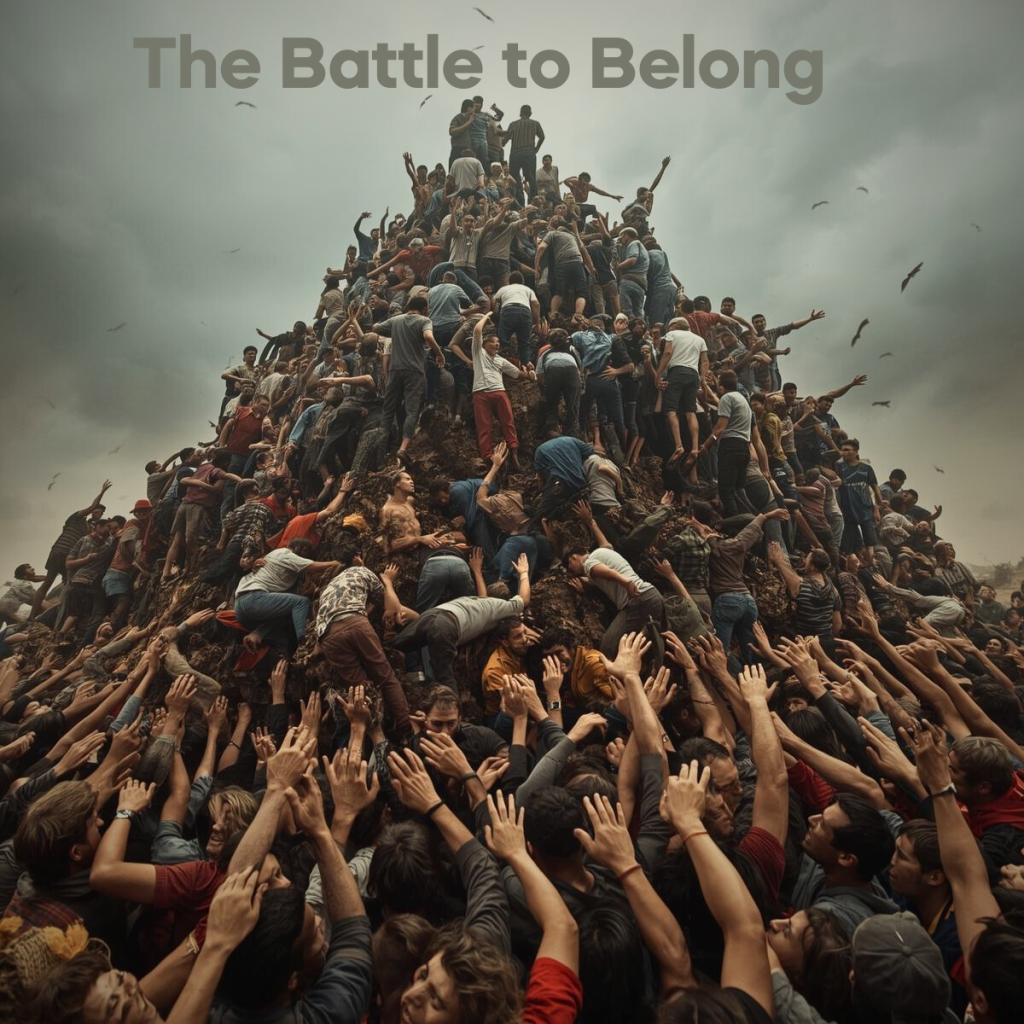
Using AI, I generated a graphic that makes it easier to imagine people competing with each other to stay as close as possible to the centre of an imaginary Circle-of-Belonging.
Nobody wants to find themselves at the edge of that circle because nothing hurts more than exclusion.
(This point has been discussed, extensively in previous newsletters.)
If you find it hard to grasp just how intense the pain of exclusion is, remember stories you've read, or shows that you've watched (including comedies) featuring characters who are confronted with exclusion, excommunication, expulsion, banishment, exile, segregation, disowning, renunciation, snubbing, or being ostracized. Once you start looking for it, you see it everywhere.
If nothing specific comes to mind, consider the basic storyline of almost every tearjerker Disney movie you’ve ever watched.
Fear of expulsion compels the people most afraid of exclusion to trample anyone standing between them and the centre of the circle-of-inclusion.
What they covet more than anything is to BE THE ONE WHO DECIDES who gets to be included and who gets pushed out.
Take a close look at the most powerful person or people in your community, on your team and in your workplace. Very often, those who hold the most power are also those most strongly motivated to dominate the centre (exercising overt or covert force whenever they sense that control is slipping).
Look at those in the world who have accumulated the most wealth, prestige and influence. How anxious are these individuals, families and groups about the possibility of being excluded?
To what extent might their relentless drive for more—more status, more control, more assets—be a strategy for anchoring their position in the circle?
Can you identify the people at your workplace, in your community, your town, village or city, the province or state where you live, who are working hardest to ensure that they determine who belongs and who doesn’t?
Who dominates the organizations, societies, faith groups, sports clubs and associations that you belong to?
Who steers the strata council, school board or any other local governance structures you’re part of?
Since no one is safe, everyone is forced to compete.
Where are YOU the person with the most power to determine who belongs and who gets excluded—or the person striving to get closer to the power-broker?
THERE IS NO SHAME IN THIS, because as I asserted earlier, every one of us feels afraid of experiencing the unbearable pain of exclusion.
Tyranny
People do terrible things to others when they’re desperate to maintain control over who gets to belong and who must be excluded.
Adolf Hitler, for example, a man well acquainted with the pain of exclusion, went as far as co-opting entire nations to exclude and to dehumanize Jews, Homosexuals, Romani, Communists, Social Democrats, Trade Unionists and Jehovah's Witnesses by making them choose between complicity in his genocide (inclusion) or being a victim of his genocide (exclusion).
Hitler was neither the first, nor the last tyrant to sacrifice thousands, or millions, of others so that he could control who is included, and to avoid being pushed over the edge of the circle-of inclusion, himself.
Hell on Earth
Without clean air, clean water, nourishing food, a healthy environment and thriving biodiversity, our species cannot survive. Yet the overwhelming need some people feel to remain in the position of deciding who gets included and who doesn’t, blinds them to the immense danger they are putting all of us in.
Oligarchs and power-holders whose decisions shape the fate of the planet are driven by this same terror of exclusion—terrified of losing their place at the centre, they cling to it even as the world around them burns.
So, what can we do?
Nothing prevents you or me from using these handy-handicaps in the pursuit of health, peace, belonging and love—but doing so requires a high degree of commitment to individual growth and transformation.
By doing this, we don’t erase the human fear of exclusion—we acknowledge that it exists while consciously and intentionally countering it's effects.
We can do this, and many of us already are.
Don't Miss Out On
Original insights and content from Philip Be'er
Challenging your understanding of how humans are 'wired' and why it matters.
Copyright ©Advantages Mediation. All Rights Reserved